
What is a Colposcopy and Why is it Done?
Have you had an abnormal Pap smear and need further evaluation?
Are you experiencing unexplained symptoms such as irregular bleeding or pelvic pain?
Do you need a closer examination of your cervix, vagina, or vulva?
A colposcopy is a procedure that allows your doctor to examine your cervical, vaginal, and vulvar tissues closely using a special magnifying device called a colposcope. This procedure helps detect abnormal cells, pre-cancerous changes, and other conditions that may require further treatment.
If these questions apply to you, Dr. Bernd C. Schmid can help. With extensive experience in performing colposcopies, Dr. Schmid provides accurate diagnoses to ensure your health and peace of mind.
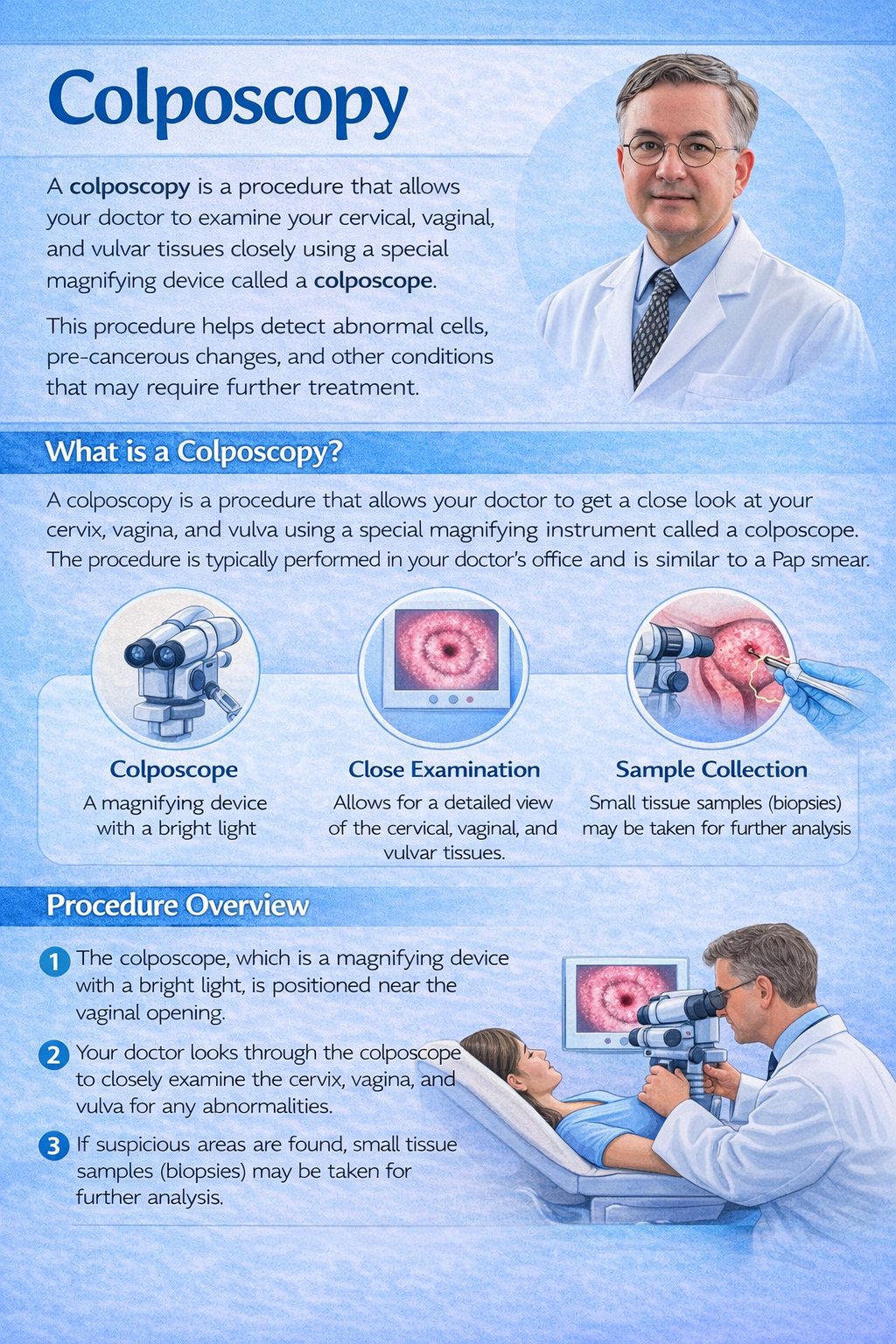
Understanding colposcopy: What the procedure involves
Colposcopy is a diagnostic procedure used to examine the cervix, vagina, and vulva in greater detail when a cervical screening test — either a Pap smear or HPV test — returns an abnormal result. It is not a treatment in itself, but a precise way of identifying whether abnormal cells are present and, if so, where they are located, so that targeted biopsies can be taken. The goal is early detection of precancerous changes before they have the opportunity to progress.
Why might I need a colposcopy?
The most common reason is an abnormal cervical screening result. Timely follow-up matters: a retrospective study of over 17,000 patients found that those who delayed colposcopy beyond twelve months after a high-grade abnormal result had more than twice the rate of cervical cancer compared with those seen within twelve months (Alimena et al., Obstetrics & Gynecology, 2023). At Dr. Schmid's Robina, Gold Coast practice, prompt assessment following an abnormal screen is a priority.
What does the procedure involve?
You will be positioned as you would for a routine pelvic examination. The cervix is examined first under bright light, then through the colposcope — a magnifying instrument positioned outside the body, roughly 30 centimetres from the cervix. A dilute acetic acid solution is applied to the cervix, which temporarily makes any abnormal cells appear white, allowing the colposcopist to identify areas of concern. A green filter light may also be used to highlight abnormal blood vessel patterns.
If abnormal areas are identified, small biopsies are taken from the most concerning sites. Current guidelines from the American Society for Colposcopy and Cervical Pathology (ASCCP) recommend targeting all acetowhite areas and obtaining at least two biopsies — an approach shown to meaningfully improve detection rates compared with a single biopsy (Gage et al., Obstetrics & Gynecology, 2006).
The procedure is generally well-tolerated. A review of 19 randomised trials found no significant reduction in pain from oral analgesics compared with placebo, and distraction techniques during biopsy — such as asking the patient to cough — have been shown to be as effective as local anaesthetic injection (Schmid et al., American Journal of Obstetrics & Gynecology, 2008).
How accurate is colposcopy?
A meta-analysis of 15 studies covering nearly 23,000 patients found that colposcopy by an experienced practitioner achieves a sensitivity of 68 percent and specificity of 93 percent for detecting high-grade lesions (Qin et al., BMC Cancer, 2023). Some patients with a normal colposcopic appearance can still have a significant abnormality on biopsy, which is why cytology, colposcopic findings, and histology are always reviewed together before decisions about management are made.
After the procedure
Biopsy results are typically available within one to two weeks and are reviewed alongside your screening history before any management recommendations are made. You will be advised to avoid intercourse for 48 hours following biopsy to minimise the risk of bleeding. Some light spotting or discharge in the days following is normal.
Dr. Schmid's approach
Dr. Schmid performs colposcopy at his Robina, Gold Coast practice and at Gold Coast Private Hospital, with extensive experience in the assessment and management of abnormal cervical screening results, including LLETZ procedures for confirmed precancerous changes even after multiple previous LLETZ procedures. Each assessment is guided by current Australian cervical screening guidelines, with the findings explained clearly at the time of your appointment.
Clinical content informed by ASCCP Colposcopy Standards (Wentzensen et al., 2017), Alimena et al. (Obstetrics & Gynecology, 2023), Gage et al. (Obstetrics & Gynecology, 2006), and Qin et al. (BMC Cancer, 2023).