
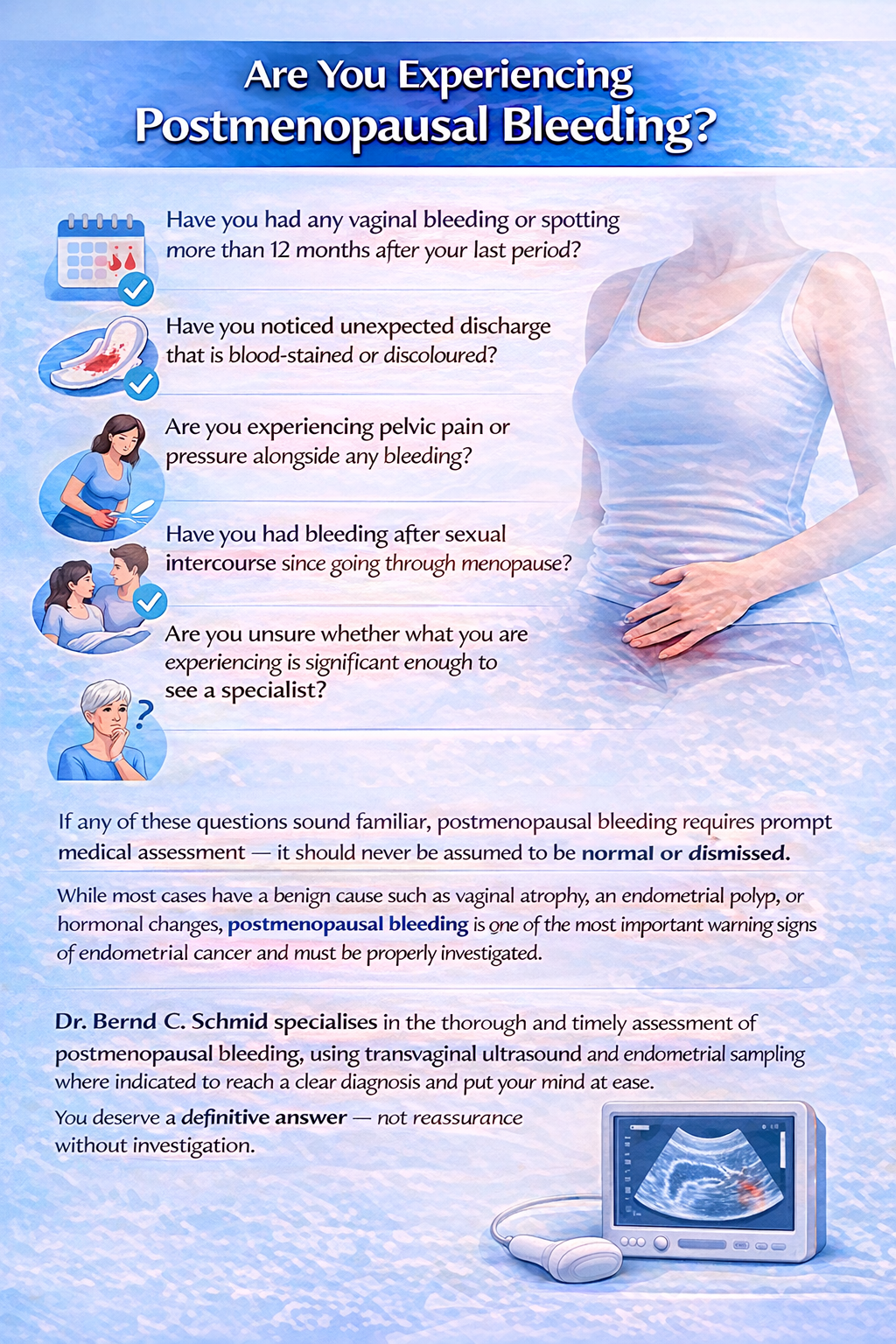
Are You Experiencing Postmenopausal Bleeding?
Have you had any vaginal bleeding or spotting more than 12 months after your last period?
Have you noticed unexpected discharge that is blood-stained or discoloured?
Are you experiencing pelvic pain or pressure alongside any bleeding?
Have you had bleeding after sexual intercourse since going through menopause?
Are you unsure whether what you are experiencing is significant enough to see a specialist?
If any of these questions sound familiar, postmenopausal bleeding requires prompt medical assessment — it should never be assumed to be normal or dismissed. While most cases have a benign cause such as vaginal atrophy, an endometrial polyp, or hormonal changes, postmenopausal bleeding is one of the most important warning signs of endometrial cancer and must be properly investigated. Dr. Bernd C. Schmid specialises in the thorough and timely assessment of postmenopausal bleeding, using transvaginal ultrasound and endometrial sampling where indicated to reach a clear diagnosis and put your mind at ease. You deserve a definitive answer — not reassurance without investigation.
Understanding postmenopausal bleeding: What the evidence tells us
Postmenopausal bleeding — any vaginal bleeding that occurs more than 12 months after your last period — is one of the most important symptoms in gynaecological practice. It should never be ignored or assumed to be normal. While the majority of cases have a benign cause, postmenopausal bleeding is the cardinal warning sign of endometrial carcinoma, and every episode requires prompt, thorough investigation.
How common is it, and what causes it?
Postmenopausal bleeding accounts for approximately 5 percent of gynaecology consultations and occurs in 4 to 11 percent of postmenopausal women. The most common causes are benign — endometrial polyps and atrophy (thinning of the uterine lining due to low oestrogen) together account for the majority of cases. A prospective study of 454 postmenopausal women with uterine bleeding found polyps in 38 percent and atrophy in 31 percent of cases, with carcinoma present in 6.6 percent (Van den Bosch et al., Facts, Views & Vision in ObGyn, 2015).
However, the overall risk of endometrial cancer in women presenting with postmenopausal bleeding is clinically significant. A systematic review and meta-analysis of 92 studies including over 31,000 women with postmenopausal bleeding found a pooled endometrial cancer risk of 9 percent overall — rising to 12 percent in women not taking menopausal hormone therapy, and to 19 percent in women with both postmenopausal bleeding and an endometrial thickness of 4 mm or more on ultrasound (Clarke et al., JAMA Internal Medicine, 2018). This is why investigation is mandatory, not optional.
Other less common causes include uterine fibroids, endometrial hyperplasia, cervical pathology, fallopian tube carcinoma, and medication effects such as anticoagulants or tamoxifen therapy.
How is postmenopausal bleeding investigated?
Assessment begins with a careful history and pelvic examination to help identify the source of bleeding and any relevant risk factors — including obesity, diabetes, family history of endometrial or colorectal cancer, and Lynch syndrome — all of which increase the probability of endometrial carcinoma.
The two key investigations are transvaginal ultrasound (TVUS) and endometrial biopsy, and both have important roles.
Transvaginal ultrasound measures the thickness of the endometrial lining. A large meta-analysis of 35 prospective studies including nearly 6,000 women with postmenopausal bleeding found that a thin endometrial stripe of 4 mm or less on high-quality ultrasound was associated with a sensitivity of 96 percent for excluding endometrial carcinoma (Smith-Bindman et al., JAMA, 1998). However, ultrasound alone cannot definitively exclude cancer — particularly in women with persistent or recurrent bleeding, or those with non-endometrioid cancer subtypes where the endometrium may appear deceptively thin.
Endometrial biopsy — a straightforward office procedure — provides a tissue diagnosis and is the preferred first-line test in many specialist practices given its high sensitivity, low complication rate, and low cost. A meta-analysis of 39 studies found that the Pipelle biopsy device achieved a sensitivity of 99.6 percent for detecting endometrial carcinoma in postmenopausal women, with specificity exceeding 98 percent across all devices (Dijkhuizen et al., Cancer, 2000). Where the biopsy is non-diagnostic or bleeding persists despite a benign result, hysteroscopy with dilation and curettage provides direct visualisation of the uterine cavity and allows targeted biopsy of any lesions present.
When does a normal result not mean the end of investigation?
Persistent or recurrent postmenopausal bleeding — even after a benign endometrial biopsy or a thin endometrial stripe on ultrasound — requires further investigation. Endometrial carcinoma can be present with a thin endometrium, and a non-diagnostic biopsy does not exclude malignancy when clinical suspicion remains. In such cases, hysteroscopy D&C is the next step.
Dr. Schmid's approach
Dr. Schmid provides prompt, thorough assessment of postmenopausal bleeding at his Robina, Gold Coast practice, including transvaginal ultrasound and endometrial biopsy where indicated. Hysteroscopy and dilation and curettage are performed when further investigation is required. The goal is always a definitive answer — not reassurance without evidence.
Clinical content informed by Clarke et al. (JAMA Internal Medicine, 2018), Van den Bosch et al. (Facts, Views & Vision in ObGyn, 2015), Smith-Bindman et al. (JAMA, 1998), and Dijkhuizen et al. (Cancer, 2000).