
Are You Experiencing Heavy Menstrual Bleeding?
Do you find yourself needing to change your pad or tampon frequently, even at night?
Are your periods lasting longer than seven days?
Do you pass large blood clots during your menstrual cycle?
Is heavy bleeding interfering with your daily activities and quality of life?
Are you experiencing symptoms of anemia, such as fatigue or shortness of breath?
If any of these questions resonate with you, Dr. Bernd C. Schmid can help. With expertise in diagnosing and treating heavy menstrual bleeding, Dr. Schmid offers effective care to address your concerns and improve your quality of life.
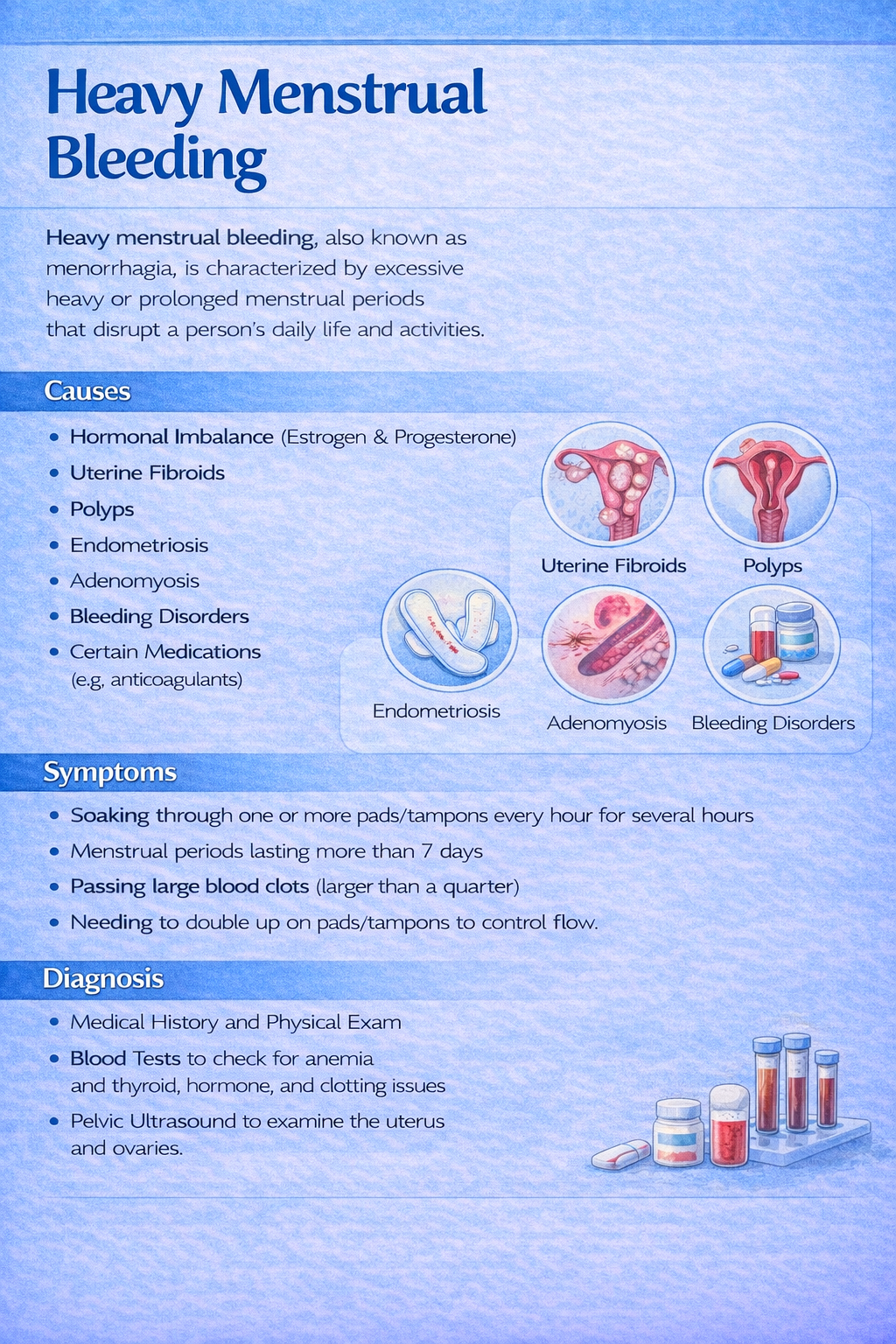
Understanding heavy menstrual bleeding: What the evidence tells us
Heavy menstrual bleeding (HMB) is one of the most common reasons women seek gynaecological care. It is defined not by a fixed measurement, but by whether the volume of bleeding interferes with your physical, social, emotional, or daily quality of life — a definition that places your experience at the centre of the assessment. It is worth noting that many women have had heavy periods normalised by family members or health professionals over years, and may not realise that what they are experiencing is beyond what is typical. When menstrual blood loss is measured directly in research settings, the threshold for HMB is more than 80 mL per cycle — but in clinical practice, your own perception of how bleeding affects your life is what matters most.
What causes heavy menstrual bleeding?
HMB rarely has a single cause. The most common structural causes include uterine fibroids, endometrial polyps, and adenomyosis. Ovulatory dysfunction — where cycles are irregular or anovulatory — is another frequent contributor, particularly at the extremes of reproductive life. Bleeding disorders are more common in this population than is often recognised: the prevalence of von Willebrand disease among women with chronic heavy periods is substantially higher than the general population rate of approximately 1 percent (Kadir et al., The Lancet, 1998). Thyroid dysfunction, certain medications including anticoagulants, and, rarely, endometrial hyperplasia or cancer can also present with HMB. A large cohort study found that women initiating oral anticoagulants had nearly double the rate of abnormal uterine bleeding compared with matched controls (Yellin et al., Obstetrics & Gynecology, 2026).
How is it assessed?
Assessment begins with a thorough history — including your menstrual pattern, associated symptoms such as pain or bloating, contraceptive use, and any family history of bleeding disorders — followed by a pelvic examination. Pregnancy is excluded in all reproductive-age women regardless of reported sexual activity or contraceptive use.
Transvaginal ultrasound is the first-line investigation, used to identify fibroids, adenomyosis, and polyps. Where intracavitary lesions are suspected, saline infusion sonohysterography or hysteroscopy provides more detailed assessment of the uterine cavity. Blood tests including a full blood count (to check for anaemia) and ferritin (to identify depleted iron stores even before anaemia develops) are routinely performed. Testing for platelet and clotting function is recommended where a bleeding disorder is clinically suspected. Endometrial sampling is recommended for women aged 45 and over with heavy or irregular bleeding, and for younger women with persistent symptoms alongside risk factors such as obesity or chronic anovulation — given that premenopausal women with a BMI of 30 or above are approximately four times more likely to develop endometrial hyperplasia or cancer than those without these risk factors (Wise et al., American Journal of Obstetrics & Gynecology, 2016).
Treatment options
Management depends on the underlying cause, your fertility plans, and the severity of your symptoms. Medical options include the levonorgestrel-releasing IUD (Mirena), combined oral contraceptives, oral progestins, and tranexamic acid. The levonorgestrel IUD is one of the most effective medical treatments available and also provides contraception. Surgical options — including hysteroscopic removal of polyps or submucosal fibroids, endometrial ablation, and, where appropriate, hysterectomy — are considered when medical treatment is insufficient or not desired.
Dr. Schmid's approach
Dr. Schmid offers thorough assessment of heavy menstrual bleeding at his Robina, Gold Coast practice, including pelvic ultrasound, endometrial evaluation where indicated, and a full discussion of medical and surgical treatment options. Procedures including hysteroscopy, endometrial ablation, and myomectomy or hysterectomy.
Clinical content informed by Kadir et al. (The Lancet, 1998), Wise et al. (American Journal of Obstetrics & Gynecology, 2016), FIGO AUB Classification (Munro et al., 2018), and Yellin et al. (Obstetrics & Gynecology, 2026).