
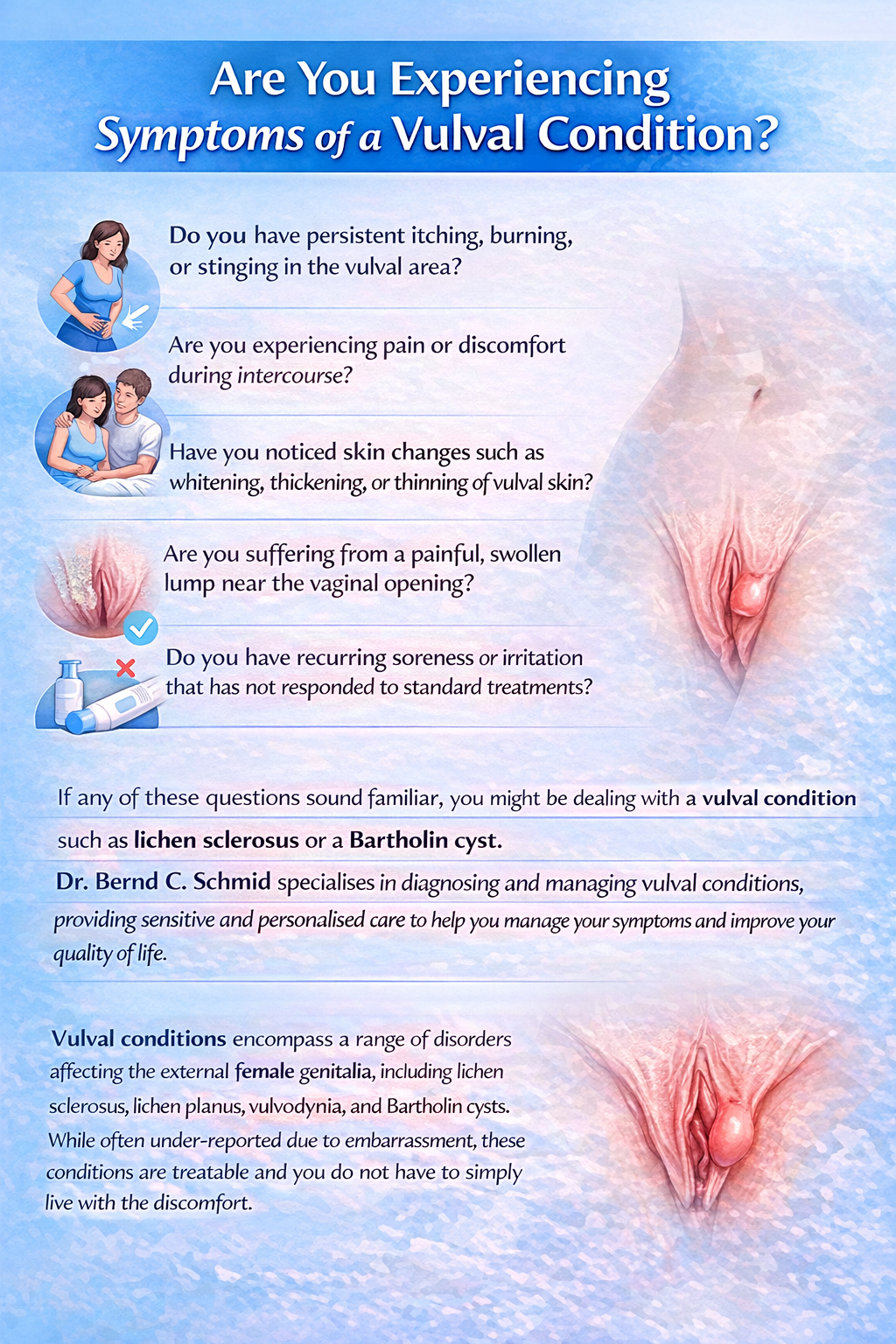
Are You Experiencing Symptoms of a Vulval Condition?
Do you have persistent itching, burning, or stinging in the vulval area?
Are you experiencing pain or discomfort during intercourse?
Have you noticed skin changes such as whitening, thickening, or thinning of the vulval skin?
Are you suffering from a painful, swollen lump near the vaginal opening?
Do you have recurring soreness or irritation that has not responded to standard treatments?
If any of these questions sound familiar, you might be dealing with a vulval condition such as lichen sclerosus or a Bartholin cyst. Dr. Bernd C. Schmid specialises in diagnosing and managing vulval conditions, providing sensitive and personalised care to help you manage your symptoms and improve your quality of life. Vulval conditions encompass a range of disorders affecting the external female genitalia, including lichen sclerosus, lichen planus, vulvodynia, and Bartholin cysts. While often under-reported due to embarrassment, these conditions are treatable and you do not have to simply live with the discomfort.
Understanding vulval conditions: What the evidence tells us
Vulval conditions are among the most commonly encountered — and most commonly misdiagnosed — problems in gynaecological practice. Many women live with symptoms for years before receiving an accurate diagnosis, and several conditions can coexist. Dr. Schmid's Robina, Gold Coast practice offers specialist assessment of the full range of vulval disorders, including the three conditions described below.
Lichen sclerosus
Lichen sclerosus is a chronic, progressive skin condition that most commonly affects the vulva. It typically causes intense itching, soreness, and skin changes including white, thinned or atrophic patches that may involve the labia, clitoris, perineum, and perianal skin in a characteristic keyhole distribution. As the condition progresses, it can cause significant architectural change — loss of the labia minora, burying of the clitoris, and narrowing of the vaginal opening — leading to pain during intercourse and difficulty with penetration.
The condition has two peak periods of onset: the prepubertal years and the perimenopausal to postmenopausal period. It is thought to involve an autoimmune mechanism, and women with lichen sclerosus have an increased prevalence of other autoimmune conditions including thyroid disease and vitiligo. A large registry-based study of approximately 150,000 women with lichen sclerosus confirmed these associations (Jerkovic Gulin et al., Journal of Clinical Medicine, 2024).
The most important long-term concern is a modestly increased risk of vulval squamous cell carcinoma. A retrospective cohort study of over 3,000 women found that approximately 3 percent subsequently developed vulval cancer, with a median time to diagnosis of 3.3 years (Bleeker et al., Cancer Epidemiology, Biomarkers & Prevention, 2016). Critically, a prospective cohort study of 507 women followed over six years found that consistent adherence to topical corticosteroid maintenance therapy was associated with a significantly lower rate of vulval neoplasia — with no cases among the 357 adherent patients, compared with 4.7 percent in the less adherent group (Lee et al., JAMA Dermatology, 2015). This underlines why ongoing treatment and follow-up matter even when symptoms are well controlled.
First-line treatment is a superpotent topical corticosteroid such as clobetasol propionate 0.05% ointment, used initially nightly and then tapered to the lowest effective maintenance frequency. Long-term follow-up is recommended.
Lichen planus
Vulval lichen planus is an inflammatory condition that can present in several forms, of which erosive lichen planus is the most severe and the most commonly seen in specialist settings. It causes well-demarcated, glazed erosions — often with a characteristic white lacy border — on the vulval vestibule and labia minora, frequently accompanied by vaginal involvement. Unlike lichen sclerosus, vaginal involvement is common in erosive lichen planus, occurring in up to 70 percent of cases, and can lead to scarring, vaginal synechiae, and progressive stenosis if untreated.
Symptoms include vulval burning, pain, dyspareunia, and an irritating vaginal discharge that does not respond to standard treatments for vaginitis. A questionnaire-based Delphi consensus process involving 73 international experts identified nine key diagnostic features, with well-demarcated erosions, a white hyperkeratotic border, scarring, and vaginal involvement among the most agreed-upon criteria (Simpson et al., British Journal of Dermatology, 2013).
A prospective study of 114 women with erosive lichen planus treated with topical clobetasol ointment found that 94 percent experienced good or partial symptomatic improvement, and 71 percent achieved complete resolution of symptoms during treatment (Cooper & Wojnarowska, Archives of Dermatology, 2006). For vaginal involvement, intravaginal corticosteroid foam or suppositories are the first-line approach. Dilators may be needed to address early synechiae, and surgical release is sometimes required for severe vaginal occlusion. Second-line options for treatment-refractory disease include topical tacrolimus and systemic immunosuppressants.
An association with vulval squamous cell carcinoma has been reported, though the magnitude of risk remains less clearly quantified than for lichen sclerosus. Regular surveillance is recommended.
Bartholin gland cysts and abscesses
The Bartholin glands sit on either side of the vaginal opening and produce lubrication during arousal. When the duct becomes blocked, a Bartholin cyst forms — usually painless and discovered incidentally. If the blocked duct becomes infected, a Bartholin abscess develops, presenting with rapid-onset severe pain and swelling that makes walking, sitting, and sexual intercourse difficult or impossible.
The most common causative organism is Escherichia coli rather than sexually transmitted bacteria, though gonorrhoea and chlamydia testing is appropriate at the time of drainage in women at risk. A retrospective study of 219 women with Bartholin abscesses found E. coli to be the single most common pathogen (Kessous et al., Obstetrics & Gynecology, 2013).
Most abscesses are managed with incision and drainage combined with Word catheter placement to keep the tract open and reduce recurrence. A meta-analysis of eight randomised trials in nearly 700 patients found no significant difference in recurrence rates between Word catheter placement and marsupialization — though the catheter is preferred for most first and second episodes given it can be performed under local anaesthesia in an outpatient setting (Illingworth et al., BJOG, 2020). For women with recurrent abscesses after multiple procedures, marsupialization or excision of the gland may be offered.
Biopsy of the gland wall is recommended for postmenopausal women, where any Bartholin gland mass warrants histological assessment to exclude the rare but important diagnosis of Bartholin gland carcinoma.
Dr. Schmid's approach
Dr. Schmid offers specialist assessment and management of all vulval conditions at his Robina, Gold Coast practice. For lichen sclerosus and lichen planus, this includes clinical diagnosis, biopsy where indicated, and individualised treatment plans with ongoing surveillance. Bartholin procedures including incision and drainage and marsupialization are performed at Gold Coast Private Hospital.
Clinical content informed by Bleeker et al. (Cancer Epidemiology, Biomarkers & Prevention, 2016), Lee et al. (JAMA Dermatology, 2015), Cooper & Wojnarowska (Archives of Dermatology, 2006), Simpson et al. (British Journal of Dermatology, 2013), Kessous et al. (Obstetrics & Gynecology, 2013), and Illingworth et al. (BJOG, 2020).