
Are You Experiencing Symptoms of Menopause or Perimenopause?
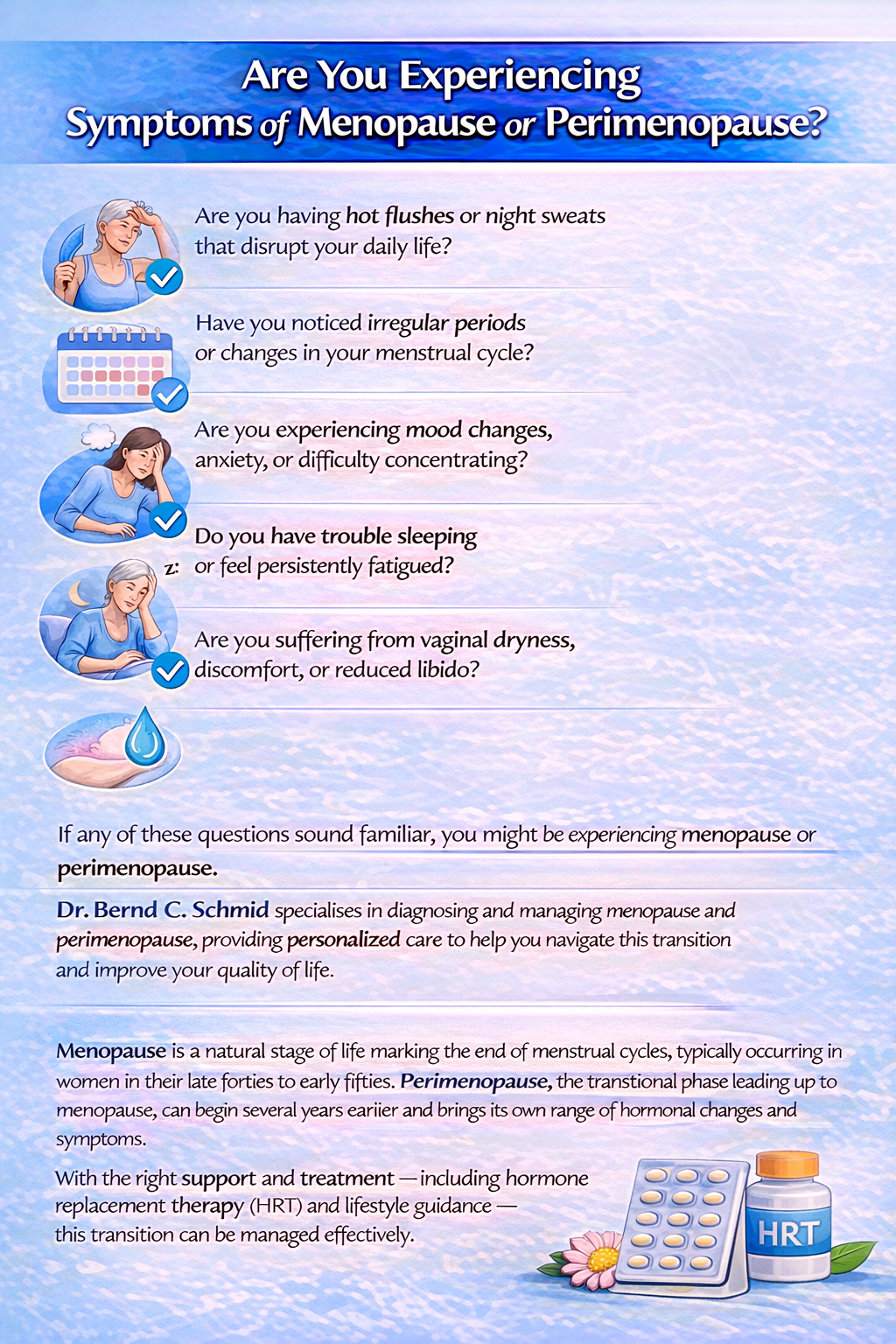
Are you having hot flushes or night sweats that disrupt your daily life?
Have you noticed irregular periods or changes in your menstrual cycle?
Are you experiencing mood changes, anxiety, or difficulty concentrating?
Do you have trouble sleeping or feel persistently fatigued?
Are you suffering from vaginal dryness, discomfort, or reduced libido?
If any of these questions sound familiar, you might be experiencing menopause or perimenopause. Dr. Bernd C. Schmid specialises in diagnosing and managing menopause and perimenopause, providing personalised care to help you navigate this transition and improve your quality of life. Menopause is a natural stage of life marking the end of menstrual cycles, typically occurring in women in their late forties to early fifties. Perimenopause, the transitional phase leading up to menopause, can begin several years earlier and brings its own range of hormonal changes and symptoms. With the right support and treatment — including hormone replacement therapy (HRT) and lifestyle guidance — this transition can be managed effectively.
Understanding menopause and perimenopause: What the evidence tells us
Menopause is defined as 12 consecutive months without a menstrual period, occurring at a median age of 51.4 years. The years leading up to menopause — the menopausal transition or perimenopause — begin on average around age 47 and are characterised by increasingly irregular cycles, hormonal fluctuations, and a wide range of symptoms. Understanding this transition is important not only for managing symptoms now, but for protecting your long-term health.
Hot flushes and vasomotor symptoms
The most common and well-recognised symptom of the menopausal transition is the hot flush — a sudden sensation of heat centred on the chest and face, often accompanied by sweating, palpitations, and sometimes chills. Hot flushes affect up to 80 percent of women and, when they occur at night, significantly disrupt sleep. Contrary to what was long believed, symptoms do not necessarily resolve within a few years. Data from the Study of Women's Health Across the Nation (SWAN) — a landmark multiethnic cohort study following over 3,000 women for 15 years — found that the median total duration of vasomotor symptoms was 7.4 years, with symptoms persisting for a median of 4.5 years after the final menstrual period. Women who first experienced hot flushes while still premenopausal had a total duration exceeding 11 years in some groups (Avis et al., JAMA Internal Medicine, 2015).
Mood, sleep, and cognitive changes
The menopausal transition is also associated with a significantly increased risk of new-onset depression. A within-woman longitudinal study found that a diagnosis of depression was 2.5 times more likely to occur during the menopausal transition compared with when the same woman was premenopausal (Bromberger et al., Archives of General Psychiatry, 2010). Sleep disturbance affects 38 to 46 percent of women in the late transition — not only because of night sweats, but also due to primary sleep disorders, anxiety, and other factors that co-occur during this life stage. Many women also describe difficulties with word retrieval, concentration, and memory, though these cognitive changes during the transition are typically transient.
Genitourinary syndrome of menopause
Genitourinary syndrome of menopause — previously called vaginal atrophy — affects approximately 50 percent of menopausal women and encompasses vaginal dryness, discomfort during intercourse, urinary urgency, and recurrent urinary tract infections. Unlike hot flushes, which often improve over time, genitourinary symptoms typically worsen progressively without treatment. They are highly responsive to local vaginal oestrogen therapy, which remains one of the safest and most effective interventions available.
Long-term consequences of oestrogen deficiency
Menopause carries significant long-term health implications that are often underappreciated. Bone loss accelerates sharply in the year before and the two years after the final menstrual period. Cardiovascular risk factors also change during this period — longitudinal data from over 2,500 SWAN participants showed a measurable increase in LDL cholesterol across the menopausal transition independent of age (Derby et al., American Journal of Epidemiology, 2009). These changes underscore why the menopausal transition is an important window for assessing and addressing long-term health risk.
Treatment: What the evidence supports
Menopausal hormone therapy (MHT) — either oestrogen alone for women who have had a hysterectomy, or oestrogen combined with a progestogen for women with an intact uterus — remains the most effective treatment for vasomotor symptoms and also protects against bone loss. Current evidence and guidance from the Menopause Society, the Endocrine Society, and the International Menopause Society no longer recommend a fixed maximum duration of treatment in symptomatic women, recognising that many women remain symptomatic well beyond the five-year threshold that was previously applied.
The decision to use MHT involves a genuine weighing of benefits against risks that is individual to each woman. The most clinically significant concern is breast cancer: combined oestrogen-progestogen therapy is associated with a small but real increase in breast cancer risk, an association confirmed in large-scale studies including the Women's Health Initiative. The risk with oestrogen-only therapy in women who have had a hysterectomy appears lower. Other relevant risks include venous thromboembolism, particularly with oral formulations — transdermal preparations are generally considered to carry a lower clot risk than oral tablets. For most healthy, symptomatic women under 60 or within ten years of menopause, current guidance from the Menopause Society and Endocrine Society supports MHT as appropriate when symptoms significantly affect quality of life and no contraindications are present. Duration of use should be reviewed regularly and individualised — not automatically capped at five years, but not extended without ongoing reassessment of the risk-benefit balance either. MHT is generally not appropriate for women with a history of breast cancer, a prior blood clot, or active cardiovascular disease.
For women who cannot take or choose not to take hormone therapy, effective non-hormonal options are available. Among the best-studied pharmacological alternatives, SSRIs and SNRIs have demonstrated meaningful reductions in hot flush frequency in pooled analyses and individual randomised trials. A pooled analysis of seven SSRI/SNRI trials and three gabapentin trials found statistically significant reductions in hot flush frequency compared with placebo (Loprinzi et al., Journal of Clinical Oncology, 2009). Gabapentin, particularly at bedtime for women with predominantly nocturnal symptoms, is another well-established option.
Dr. Schmid's approach
Dr. Schmid provides comprehensive assessment of the menopausal transition and menopause at his Robina, Gold Coast practice. This includes evaluation of vasomotor and genitourinary symptoms, bone health risk assessment, cardiovascular risk factor review, and a personalised treatment plan covering both hormonal and non-hormonal options. For women with a history of conditions such as endometriosis or PCOS who are approaching menopause, management is tailored to reflect their individual history.
Clinical content informed by Avis et al. (JAMA Internal Medicine, 2015), Bromberger et al. (Archives of General Psychiatry, 2010), Derby et al. (American Journal of Epidemiology, 2009), Loprinzi et al. (Journal of Clinical Oncology, 2009), Johnson et al. (Journal of Clinical Endocrinology & Metabolism, 2023), and the Menopause Society 2023 Non-Hormone Therapy Position Statement.