
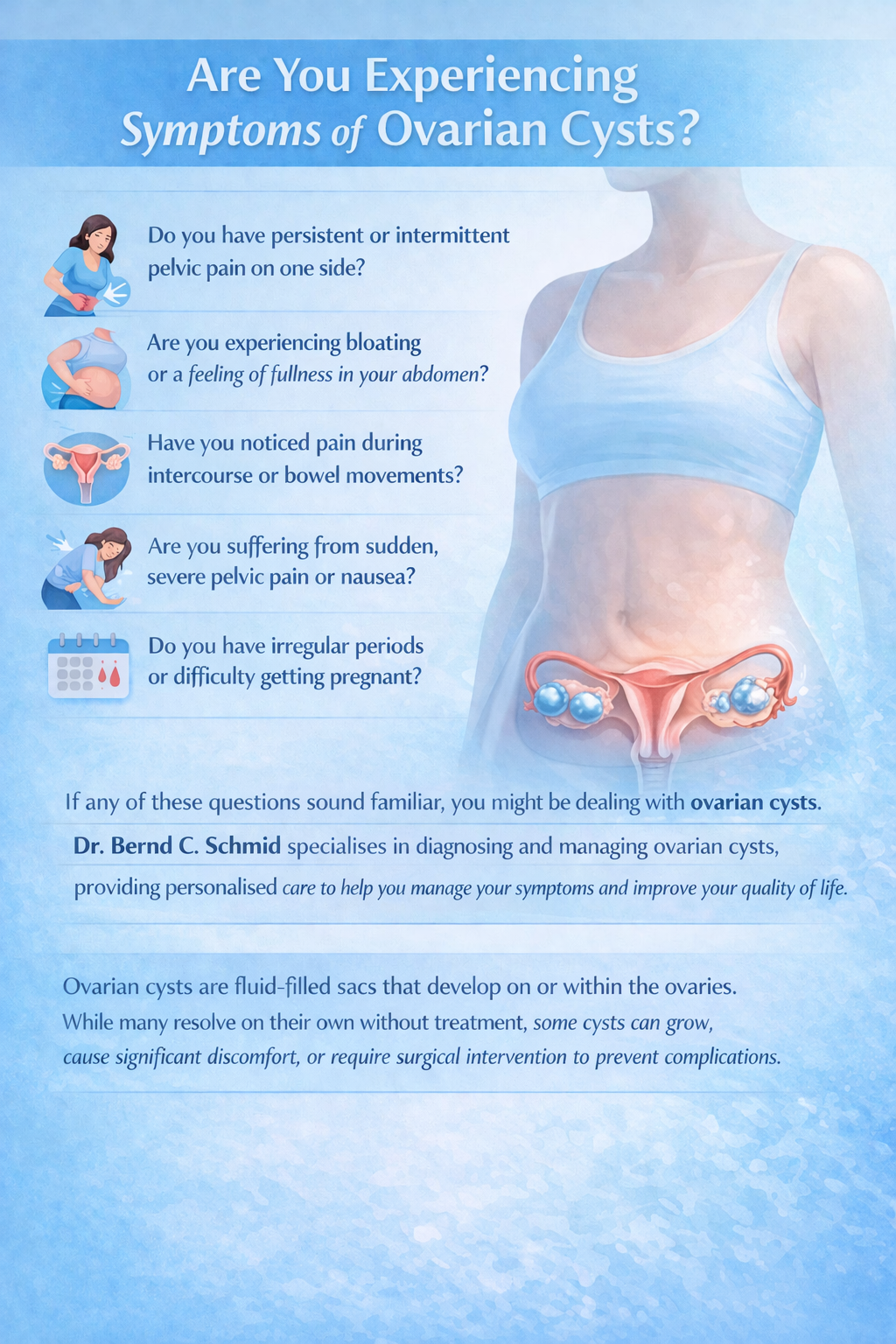
Are You Experiencing Symptoms of Ovarian Cysts?
Do you have persistent or intermittent pelvic pain on one side?
Are you experiencing bloating or a feeling of fullness in your abdomen?
Have you noticed pain during intercourse or bowel movements?
Are you suffering from sudden, severe pelvic pain or nausea?
Do you have irregular periods or difficulty getting pregnant?
If any of these questions sound familiar, you might be dealing with ovarian cysts. Dr. Bernd C. Schmid specialises in diagnosing and managing ovarian cysts, providing personalised care to help you manage your symptoms and improve your quality of life. Ovarian cysts are fluid-filled sacs that develop on or within the ovaries. While many resolve on their own without treatment, some cysts can grow, cause significant discomfort, or require surgical intervention to prevent complications.
Understanding ovarian cysts: What the evidence tells us
Ovarian cysts are extremely common. Studies show they are found in approximately 8 to 35 percent of premenopausal women and 3 to 17 percent of postmenopausal women on pelvic ultrasound. The great majority are benign — most are physiological cysts that form as a normal part of the menstrual cycle and resolve without treatment. The clinical challenge lies in accurately identifying the small proportion that require further investigation or surgery, while avoiding unnecessary intervention for the many that do not.
What symptoms can ovarian cysts cause?
Many cysts produce no symptoms at all and are discovered incidentally during an ultrasound ordered for another reason. When symptoms are present, pelvic pain or pressure is the most common — typically unilateral and variable in character. Some cysts cause a sudden, sharp pain if they rupture. In a large population-based study following over 72,000 women with simple ovarian cysts for up to 14 years, only one patient among 15,305 with a confirmed simple cyst was subsequently diagnosed with ovarian cancer — underscoring how rarely a straightforward-looking cyst represents something serious (Smith-Bindman et al., JAMA Internal Medicine, 2019).
How is the risk assessed?
Assessment is based primarily on the ultrasound appearance of the cyst, alongside clinical factors such as your age, menopausal status, symptoms, and any relevant family history. The American College of Radiology Ovarian-Adnexal Reporting and Data System (O-RADS) provides a standardised framework for classifying cysts from almost certainly benign (less than 1 percent malignancy risk) through to high risk (50 percent or more). The CA 125 blood test is used selectively — routinely in postmenopausal women with a suspicious mass, but more cautiously in premenopausal women where it is frequently elevated by benign conditions. Where ultrasound findings are unclear, MRI provides more detailed tissue characterisation and reduces false-positive diagnoses.
When is treatment needed?
Most cysts in premenopausal women require no treatment — watchful waiting with repeat ultrasound is both safe and appropriate. An interim analysis of the large international IOTA 5 study, following nearly 1,900 women with newly diagnosed adnexal masses under surveillance, found that 20 percent resolved spontaneously within two years, while the risk of invasive malignancy during follow-up was only 0.4 percent (Froyman et al., The Lancet Oncology, 2019). Surgery is recommended when a cyst shows high-risk features on imaging, reaches 5 cm or more (risk of torsion), causes persistent or severe symptoms, or when tumour markers are significantly elevated.
When surgery is needed, the approach is guided by your age and fertility plans. In premenopausal women, ovarian cystectomy — removing the cyst while preserving the ovary — is generally preferred over oophorectomy. A minimally invasive laparoscopic approach is used wherever possible. For postmenopausal women with a suspicious mass, oophorectomy is typically performed, with referral to a gynaecologic oncologist when malignancy is a significant concern.
Dermoid cysts (mature teratomas)
A specific type of cyst worth noting is the mature cystic teratoma, or dermoid cyst — the most common ovarian neoplasm in reproductive-age women, with peak incidence between 20 and 40 years. Dermoids are often benign, with malignant transformation occurring in 0.5 to 3 percent of cases, most commonly in women over 45 or with cysts larger than 10 cm. When surgery is required, laparoscopic cystectomy is the standard approach, with careful technique to minimise the risk of cyst rupture and preserve ovarian tissue.
Dr. Schmid's approach
Dr. Schmid offers thorough assessment of ovarian cysts at his Robina, Gold Coast practice, using transvaginal ultrasound as the primary evaluation tool. MRI is arranged where needed for further characterisation. Management decisions — whether surveillance, medical management, or surgery — are made on an individual basis, with laparoscopic surgery.
Clinical content informed by Smith-Bindman et al. (JAMA Internal Medicine, 2019), Froyman et al. (The Lancet Oncology, 2019), and ACR O-RADS Guidelines (Andreotti et al., Radiology, 2020).