
Do You Have Symptoms of Adenomyosis?
Are you experiencing heavy or prolonged menstrual bleeding?
Do you suffer from severe menstrual cramps or chronic pelvic pain?
Have you noticed bloating or a feeling of pressure in your lower abdomen?
Is intercourse painful for you?
Are you struggling with unexplained fatigue or anemia?
If any of these questions sound familiar, you might be dealing with adenomyosis. Dr. Bernd C. Schmid specializes in managing this condition, offering personalized care to help alleviate your symptoms and improve your quality of life. Adenomyosis is a condition where the inner lining of the uterus breaks through the muscle wall, causing heavy menstrual bleeding, severe cramps, and chronic pelvic pain. If you experience these symptoms, Dr. Bernd C. Schmid can provide expert care and treatment options to help manage your condition and improve your quality of life.
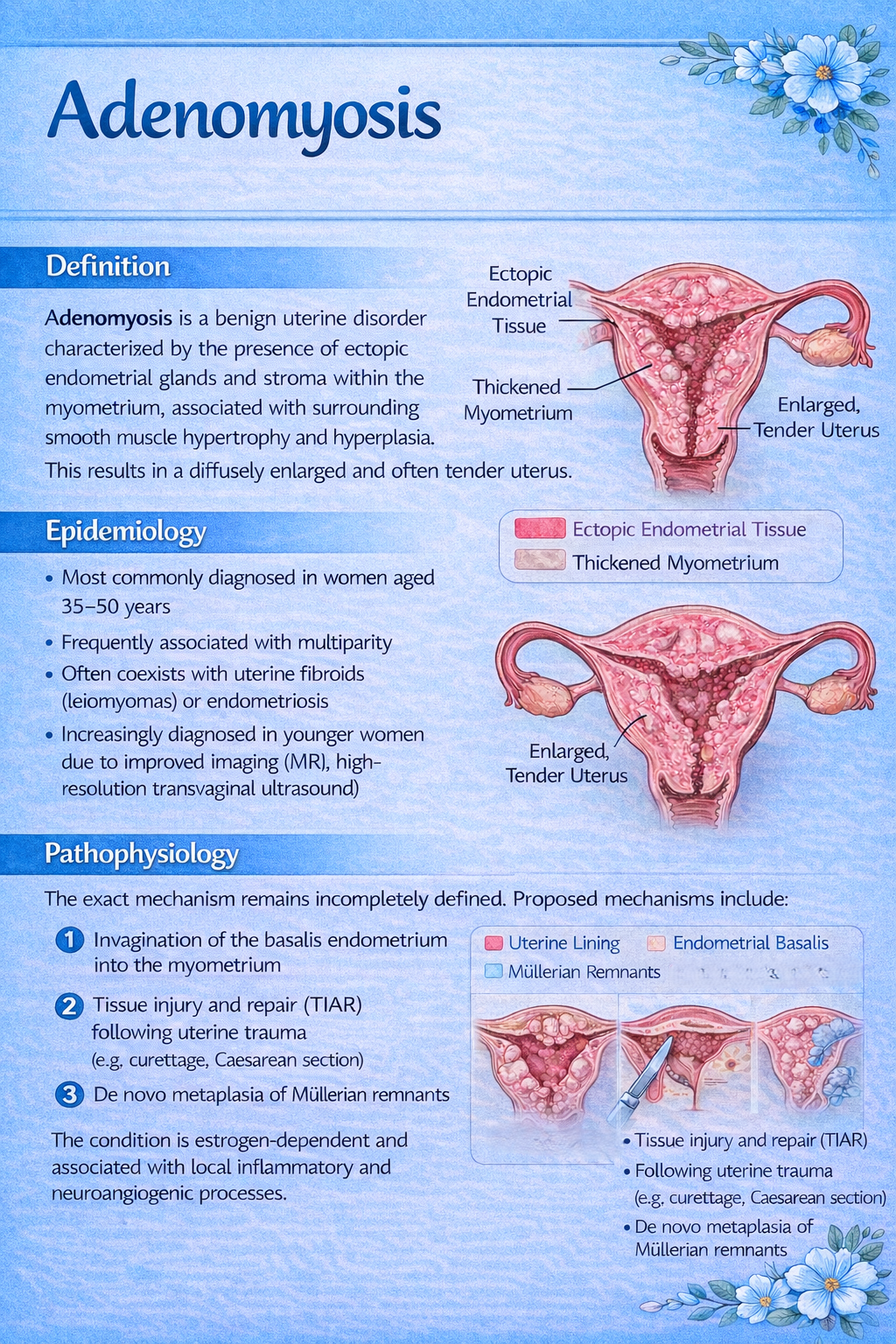
Understanding adenomyosis: What the evidence tells us
Adenomyosis occurs when the tissue that normally lines the uterus grows into the muscular wall of the uterus itself, causing it to become enlarged and, for many women, the source of significant pain and heavy bleeding. It is more common than once thought — studies using ultrasound imaging have found prevalence rates of 20 to 35 percent in women of reproductive age, with one study reporting a mean age at diagnosis of just 26 years (Pinzauti et al., Ultrasound in Obstetrics & Gynaecology, 2015). It frequently coexists with endometriosis and uterine fibroids, which can make diagnosis more challenging.
What symptoms does it cause?
Heavy menstrual bleeding affects approximately 50 to 60 percent of women with adenomyosis, and painful periods occur in 25 to 80 percent, depending on the extent of disease. Some women also experience chronic pelvic pain outside of their period. Importantly, adenomyosis can also affect fertility and pregnancy outcomes — a meta-analysis of over 1,100 patients found that women with adenomyosis had significantly higher rates of preterm birth and small-for-gestational-age infants compared with those without the condition (Bruun et al., Acta Obstetricia et Gynecologica Scandinavica, 2018). Its impact on IVF outcomes has also been documented: a meta-analysis of 11 cohort studies involving over 2,000 IVF patients found lower implantation, clinical pregnancy, and live birth rates in women with adenomyosis (Younes & Tulandi, Fertility and Sterility, 2017).
How is it diagnosed?
Adenomyosis may be diagnosed using transvaginal ultrasound or MRI. Both have similar but not very good sensitivity, but MRI offers higher specificity and lower false positive rates — making it particularly useful when planning surgery or when the ultrasound picture is uncertain. Both techniques may miss adenomyosis although you have it. No blood test can diagnose adenomyosis. On examination, the uterus is typically enlarged, soft, and tender.
Treatment options
Treatment is tailored to your symptoms and whether you wish to preserve fertility.
For most women, the first step is medical management. The 52 mg levonorgestrel-releasing intrauterine device (Mirena IUD) is supported by observational studies showing meaningful reductions in both pain and bleeding, as well as a measurable reduction in junctional zone thickness on MRI. A randomised clinical trial directly comparing the LNG-IUD with the oral contraceptive pill found that both reduced symptoms, but the IUD produced larger improvements (Shaaban et al., Contraception, 2015). For women who cannot use the IUD, oral contraceptives, progesterone-only therapies, or GnRH-based medications are alternatives.
Where medical treatment has failed and childbearing is complete, hysterectomy remains the definitive cure.
Dr. Schmid's approach
Dr. Schmid offers comprehensive assessment of adenomyosis at his Robina, Gold Coast practice, including transvaginal ultrasound evaluation and, where needed, referral for MRI. Treatment planning takes into account your symptoms, fertility goals, and the extent of disease. Both medical management and minimally invasive surgical options are available.
Clinical content informed by current evidence including Bruun et al. (2018), Younes & Tulandi (2017), Shaaban et al. (2015), and Mikos et al. (2020).